
The office of sheriff varies considerably from one state and county to another. Sheriffs are generally elected county-level law enforcement officials, but their qualifications, duties, term lengths, and responsibilities depend on state law and the jurisdiction they serve.
If you are considering a run for sheriff, start by learning exactly what the office is responsible for in your county. You may think you know the job, but you should be familiar with all the duties the office encompasses. Also, you’ll need to know what qualifications you must meet to appear on the ballot. From there, you can begin building a campaign around your personal experience, priorities, and reasons for seeking the office.
A sheriff’s duties may include:
- Keeping the peace and enforcing the law
- Investigating crimes within the office’s jurisdiction
- Overseeing county jail or correctional operations where applicable
- Acting as law enforcement for unincorporated areas of the county,
- Providing security at local government buildings like court houses and voting precincts
- Maintaining law and order at large public events while working with other law enforcement agencies (like police departments)
- Handling emergency situations
- Serving civil process or carrying out other court-related responsibilities
Not every sheriff’s office performs all of these functions. In some counties, municipal police, corrections agencies, court officers, or other departments handle responsibilities that fall to the sheriff elsewhere. Understanding the role and duties of the office you want to lead should be one of your first steps when you run for office.
Get Your Campaign Website in Place Early
Once your campaign gets underway, there will always be something more urgent to do. Setting up your website early gives you a place to introduce yourself, explain your positions, collect supporters, and accept donations when you are ready.
Online Candidate can build and set up your campaign website for you, or you can create your own with our Monthly Campaign Website Builder starting at $29/month.
Did you know? The word “sheriff” comes from the Anglo-Saxon words “shire reeve” which means “county protector.” It was originally used to describe their role as an officer or overseer of a shire or territory at least two centuries before police forces existed.
What are the requirements to run for sheriff?
Requirements to run for sheriff vary widely. Do not assume that requirements for becoming a deputy sheriff or police officer are the same as the legal qualifications for being elected sheriff.
Depending on the state and county, candidate qualifications may include age, residency, voter-registration requirements, law enforcement experience, certification, training, or other standards. Some jurisdictions have relatively few professional prerequisites, while others are much more specific.
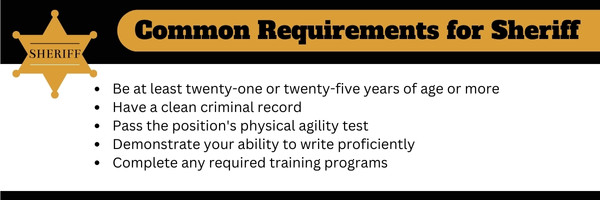
Generally, qualifications may include:
- Be at least twenty-one or twenty-five years of age or more
- Have a clean criminal record
- Pass the position’s physical agility test
- Demonstrate your ability to write proficiently
- Complete any required training programs
You may be ineligible to be sheriff if you are:
- Currently suspended or discharged from any public office
- Convicted of a felony
- Previously removed from office by court order
For broader filing and eligibility information, see our requirements to run for public office.
Running for Sheriff? Present Your Experience and Priorities Clearly
Give voters a central place to review your professional background, qualifications, public-safety priorities, endorsements, and campaign information. Your website can help you explain your experience in more depth than a sign or social media post.
Online Candidate can build and set up your campaign website for you, or you can create your own with our Monthly Campaign Website Builder starting at $29/month.
What does it take to win an election as a sheriff candidate?
Running for office can be a complex and daunting task. Experience alone does not win an election, but voters evaluating a candidate for sheriff are likely to pay close attention to leadership, judgment, professional background, and knowledge of the office.
There are certain things to know that will help you to prepare for your campaign. One is being aware of your strengths and weaknesses. You should know what your vision is, what policies you want to achieve as sheriff, and how you plan to do it.
You should also understand the political landscape of the county. An incumbent may already have substantial name recognition, while an open-seat race may attract several candidates with similar professional backgrounds. Know what distinguishes you before you begin spending money on signs, advertising, and other campaign materials.
Some common issues in sheriff campaigns
There are many community issues that a sheriff or sheriff’s office may face. A candidate needs to know what they stand for, their policies, and how they will address community issues.
Depending on the responsibilities of the office and concerns in your county, campaign issues may include:
- Public safety and crime
- Budgetary concerns
- Effective communication between law enforcement and the community
- Recruitment, staffing, and retention
- Training and professional standards
- Jail and correctional operations, where the sheriff is responsible for them
- Technology and equipment
- Coordination with municipal, state, and federal law enforcement
- Transparency and accountability
Don’t build your platform around generic “sheriff issues” or more general political issues. Your strongest positions will address actual responsibilities of the office and real local concerns.

Problems with county jails are often an issue in sheriff election campaigns.
Creating a brand for your campaign
In many ways, the process of running for office is like creating and promoting a brand. Political campaigns must choose a slogan, create a logo, and choose colors before they can start building their sheriff campaign website or creating print materials and signage.
Sheriff campaigns often use one or more of these colors:
- Blue: This color stands for security and trust. It has a strong connotation to law enforcement, which is why it is a good color choice for sheriff.
- Gold: This color offers an elegant touch, while still indicating strength and professionalism.
- Black: This color tends to be associated with power, strength, and authority.
Stars, badges, and shield-style graphics are also common in sheriff campaign logos. But be careful about copying an official badge, seal, department logo, uniform insignia, or other government branding. Rules regarding the use of official imagery vary. Your campaign materials should not create the impression that they are official communications from the sheriff’s office or county government.
Note: Most sheriff candidates may not use a photograph of themselves wearing a badge in campaign materials. Check your local laws and regulations.

A sheriff’s logo should show their seriousness and authority. The logo should be clean, simple, and direct. It needs to convey that the sheriff’s office is there to protect the community.
How to campaign as a sheriff candidate
To get elected as a sheriff, it is important to have a plan of action. This plan should include how you are going to promote your campaign, who you’re going to target, and what issues you’re going to address.
Make sure your issues are based on substance, not soundbites. To get the support of voters, you need to tell them what your plans are for improving their safety.
Sheriff races are often county-wide, which can make voter outreach more difficult than in a small municipal race. Local campaigns traditionally use signs, brochures, texting, and phone banking as ways of communicating with voters. Promoting yourself door-to-door is a time-honored and effective tradition, but it can be exhausting canvassing from house to house.
Historical election results can help you estimate how many votes you will need. Our Votes Needed to Win Calculator can help you compare turnout assumptions and develop a practical vote target.
Volunteers
Volunteers are needed for a local campaign to further the candidate’s chance of winning. Volunteers help organize fundraisers and canvass in neighborhoods. The power of a campaign can be amplified when people are willing to help. This is why grassroots campaigning relies on volunteers and supporters.
Fundraising
Successful fundraising events can be important to the success of a campaign. When you are trying to fundraise for a local political campaign, you need to know your audience and its interests. Typical fundraisers include different dinners, rallies, speeches, and outdoor events.
Put together a campaign budget before deciding how much money you’ll need for the race. County size, competitiveness, paid media, direct mail, signs, staffing, and whether you are challenging a well-known incumbent can dramatically change the cost of a sheriff race.
Make sure your campaign committee, bank account, contribution collection, and reporting procedures comply with your state and local campaign-finance requirements before soliciting donations.
Online campaigning
Today, most county sheriff departments use social media to get the word out about upcoming events, traffic updates, and crime prevention tips. There are also many sheriffs who use sites like Facebook, Twitter, and Instagram to help identify criminals. They may post pictures of suspects to get the public’s attention so they can identify the person.
Social media can also be used to promote your campaign. Organic reach is limited on most platforms, so paid advertising may be necessary to reliably reach voters. Political advertising rules and authorization requirements vary by platform and change frequently, so verify the current requirements before launching ads.
Your sheriff campaign website should be the central source for your biography, qualifications, priorities, endorsements, events, donations, and voter information. Unlike a social media account, it gives your campaign control over how that information is organized and presented.
You can also browse our sheriff campaign website design examples to see how other candidates have presented their experience, leadership, endorsements, and campaign message.
Getting voters to remember you on Election Day
Most voters don’t pay much attention to local politics, so a lot of people may be unaware of your upcoming sheriff’s election. Your campaigning goal should be to promote yourself and lay out your vision so that voters remember you on Election Day.\
Name recognition alone is not enough. Your campaign also needs to identify supporters and make sure they actually vote. As Election Day approaches, shift more attention toward turnout: reminders, early-voting information, absentee or mail-ballot deadlines where applicable, and direct follow-up with people who have expressed support.
In our experience working with local campaigns, candidates sometimes spend too much effort trying to reach everyone and too little effort following up with the people who already support them. In a lower-turnout race, getting identified supporters to vote can be just as important if not more so as expanding your voter base.
Other Frequently Asked Questions
Do I need a law degree to get elected as Sheriff?
The requirements for becoming a sheriff vary based on the jurisdiction in which the person is located. It depends on the jurisdiction. Some states or counties impose professional experience, certification, training, or other requirements, while others primarily establish age, residency, and voter-eligibility standards. Check the actual qualifications for the office rather than assuming that another county’s requirements apply to your race.
Are there any professional licenses or certification required to become a sheriff?
One of the most common misconceptions about sheriffs and deputy sheriffs is that there is a professional license or certification required to become one. It is possible to become a sheriff or deputy without any licensing requirements at all.
What does it take to become a Deputy Sheriff?
There is no single nationwide licensing or certification requirement for elected sheriffs. Requirements vary by state and county. Some jurisdictions require law enforcement experience, certification, training, or other professional qualifications, while others do not. Always verify the requirements for the specific office before filing.
Most deputy sheriffs attend a police academy after graduating high school and completing some college credits. The requirements vary by state, but generally include passing a written exam, physical exam, and background investigation before they can be sworn into office.
 =
=
Build your sheriff campaign website with Online Candidate. Choose from a monthly website builder, custom design, or complete website setup depending on how much help your campaign needs.
Related Posts
Read More:



Judicial Campaign Logo Design »
Tags: sheriff